
 1 hour ago
12
1 hour ago
12
Greece has recorded the largest reduction in public debt among the EU’s 27 member states following the pandemic crisis, according to aggregated Eurostat data announced yesterday, confirming the steady downward trend of recent years.
“Greece is recording the fastest debt reduction in history,” emphasized Minister of National Economy Kyriakos Pierrakakis in a post on X. As Kyriakos Pierrakakis highlights, the rapid reduction of debt is a deliberate government choice, aimed at ensuring it is not passed on to the next generation.
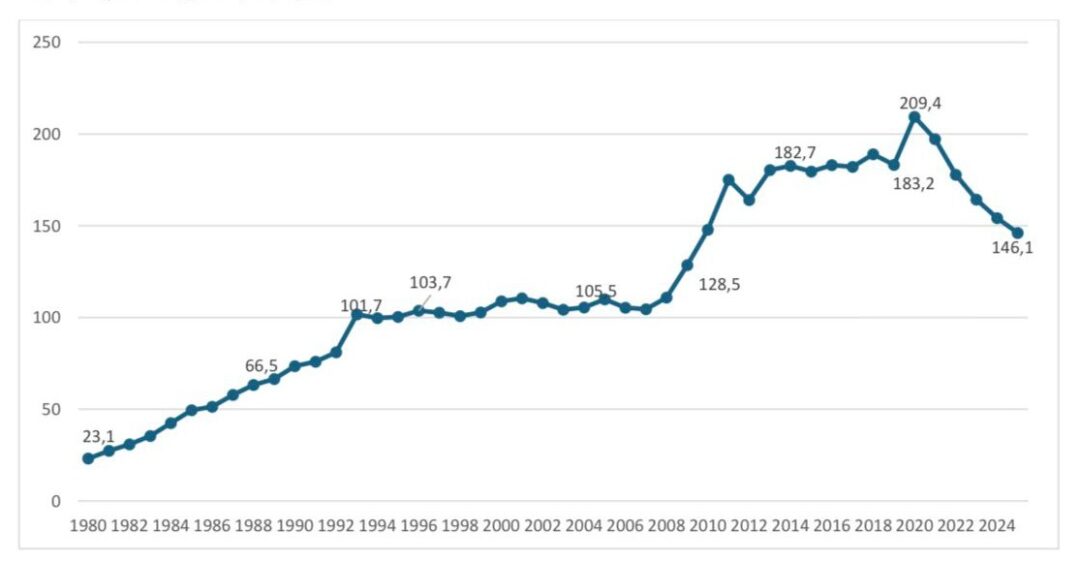
Public debt-to-GDP ratio (Source: Eurostat, AMECO)
Due to extraordinary fiscal spending and the recession caused by Covid-19, Greek debt had risen in the first quarter of 2021 to 212.9% of GDP—more than double the European average, which at that time stood at 91.5%. However, by the end of 2025, the debt-to-GDP ratio had declined to 146.1%. This decrease—amounting to nearly 67 percentage points within four years—was achieved despite the pressures on the economy from the dual energy and supply crisis triggered by Russia’s invasion of Ukraine.
In practice, Greece’s debt-to-GDP ratio has returned to its most favorable levels since the summer of 2010, that is, since the launch of the first adjustment program. This outcome is attributed to prudent fiscal policy with the creation of primary surpluses, the early repayment of loans from the first bailout program and expensive IMF loans, as well as strong growth rates that boost GDP. During the same period, the European average improved by only 9.8 percentage points. As a result, the gap between Greece and the EU narrowed to 64.4 percentage points, compared to 121.4 points recorded at the beginning of 2021. The only country with comparable performance is Cyprus, which between 2021 and 2025 improved its debt-to-GDP ratio by 62.5 percentage points. On the other hand, eight member states saw their debt increase, while major economies such as Germany and France reduced their debt-to-GDP ratios by just 5.3 and 1.5 percentage points respectively, despite their traditionally lower borrowing costs.
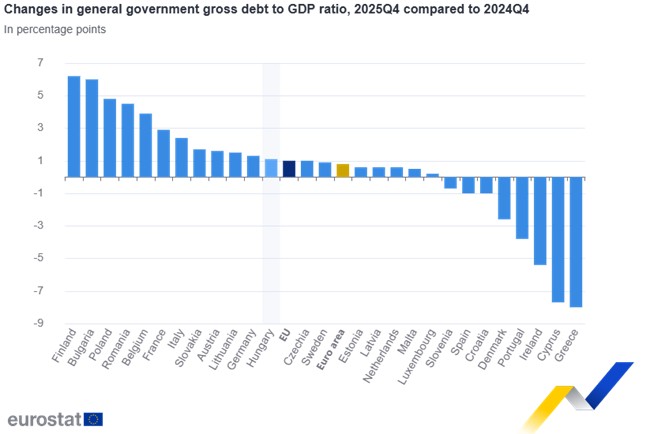
It is noted that the structure of Greek debt remains favorable, as a large portion consists of support loans from previous programs, as also highlighted by the analysis of ELSTAT. The government’s economic team continues to target a further reduction of the debt, aiming for 140% of GDP by 2027 and 120% by 2030.
(Source: https://www.amna.gr, Cover photo: Shutterstock)

Valdis Dombrovskis, Commissioner for Economy and Productivity, and for Implementation and Simplification, https://x.com/VDombrovskis/status/2047262424554705205/photo/1
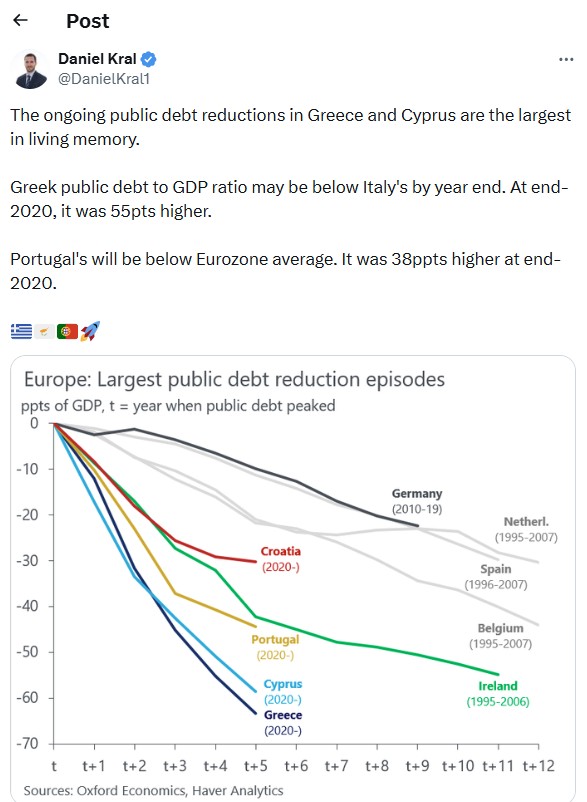
Daniel Kral – Oxford Economics, https://x.com/DanielKral1/status/2046961944570069296/photo/1
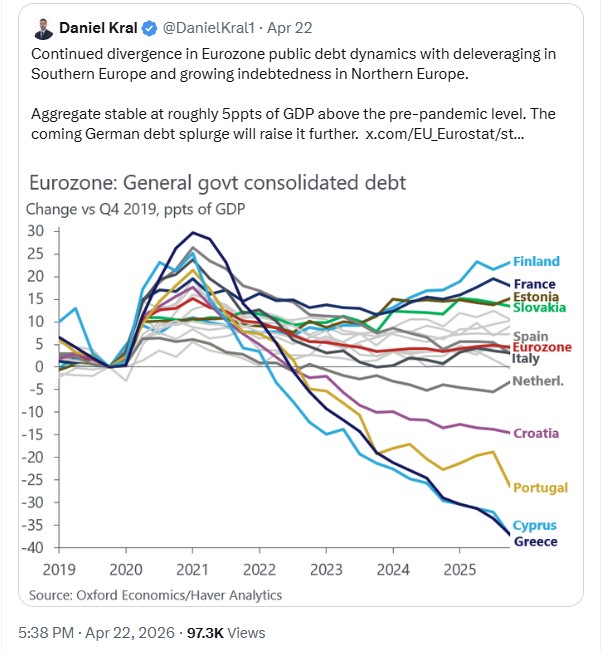
Daniel Kral – Oxford Economics, https://x.com/DanielKral1/status/2046961944570069296/photo/1
TAGS: ECONOMY | GREEK ECONOMY





 Greek (GR) ·
  English (US) ·